
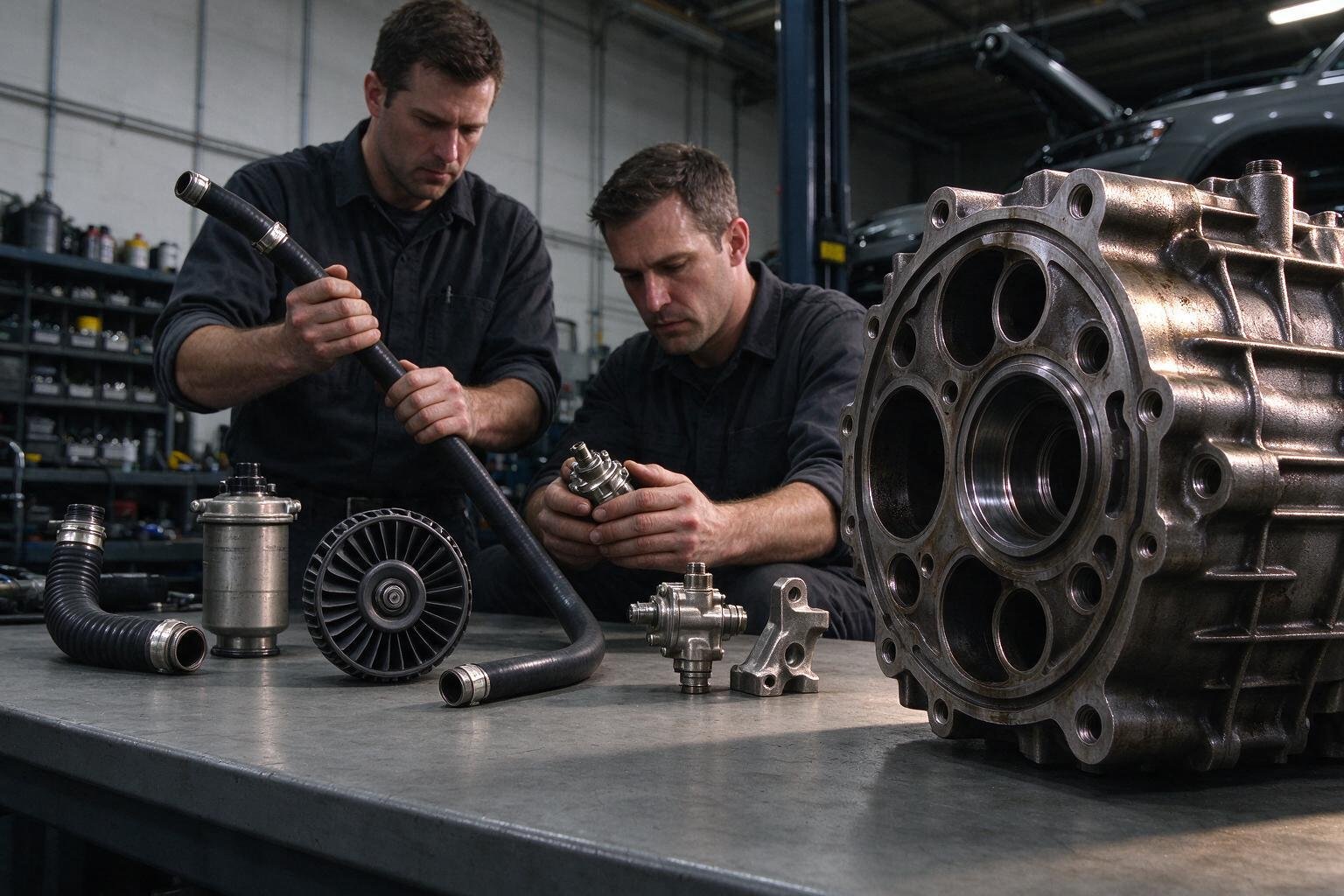
This Cummins spare parts buying guide for repair shops starts with a basic constraint: Cummins engines are not a single parts platform. The B-series, C-series, ISL, ISX, X15, and other families share a common name but differ in component design, mounting, and internal clearances, and parts from one family generally do not fit another, even when external dimensions look close enough to suggest otherwise. Displacement alone is not a reliable filter either. A given displacement can carry several build configurations that change pistons, injectors, gaskets, and sensors, and two engines of the same displacement and year may use different components depending on rating, emissions calibration, and application.
Decoding Cummins Engine Serial Numbers and Part Numbers
Accurate parts identification starts with the engine itself. The Cummins Engine Serial Number (ESN) is an eight-digit number stamped on both the engine dataplate and the block. The leading digits identify the engine family and the build period, which narrows the range of applicable components before any part number is searched.
Cummins part numbers follow structured formats, and a single component can carry a base number plus one or more supersession suffixes. Superseded numbers are common in this catalog, so a supplier quoting an obsolete number should confirm the current replacement before shipping. Shops that accept an old number without verification risk receiving a part that no longer matches the current service configuration.
At vehicle intake, capture the ESN, the CPL (Critical Parts List) number, and the full dataplate details. Recording these once allows later parts orders to be verified against the engine record without re-inspecting the vehicle. The CPL number is especially important for items such as injectors, turbochargers, and pistons, where the same engine family uses different configurations. Two engines with the same displacement may require different injectors or pistons based on their CPL.
| Data point | Location | Use in parts ordering |
|---|---|---|
| ESN (eight digits) | Dataplate and block | Identifies engine family and build period |
| CPL number | Engine dataplate | Confirms configuration-specific components |
| Dataplate details | Engine dataplate | Verifies fitment without re-inspecting the vehicle |
Matching all three data points against the supplier’s catalog reduces misorders and returns.
OEM, Genuine Remanufactured, and Aftermarket Options
Repair shops sourcing Cummins parts generally choose from three supply routes, each with a distinct cost, warranty, and risk profile.
Genuine new parts from the OEM channel carry the manufacturer’s warranty and full traceability, including part number history and lot documentation. They sit at the top of the price range, which is justified on late-model engines, warranty-sensitive repairs, and components where failure costs are high.
Genuine remanufactured components — injectors, turbochargers, cylinder heads, and pumps — are rebuilt to the manufacturer’s specification and usually carry a core charge plus a defined warranty period. The core charge is refundable when the old unit is returned in rebuildable condition, so shops should confirm core acceptance criteria before ordering. Remanufactured units typically cost less than new while retaining factory engineering control, making them a common choice for high-value assemblies.
Aftermarket parts vary widely in quality. Reputable suppliers publish material specifications, dimensional tolerances, and warranty terms in writing; buyers should request these before committing to volume orders. Suppliers who cannot document tolerances or warranty coverage present a quality risk that is difficult to assess after installation.
For safety-critical and fuel-system components, the cost of a premature failure — comebacks, labor, downtime, and potential engine damage — usually exceeds the savings from a low-cost alternative. For non-critical items such as brackets, covers, and fasteners, aftermarket sourcing is a reasonable cost-control measure, provided basic dimensional checks are performed at receipt.
| Option | Warranty | Traceability | Typical Use |
|---|---|---|---|
| Genuine new | Manufacturer warranty | Full | Late-model, warranty-sensitive repairs |
| Genuine remanufactured | Defined period, core charge | Factory rebuild records | Injectors, turbos, heads, pumps |
| Aftermarket | Supplier-defined, varies | Limited unless documented | Brackets, covers, fasteners |
Verifying Supplier Quality and Traceability
Repair shops should treat documentation as a condition of purchase, not an afterthought. For every shipment, request the manufacturer name, part number, and batch or lot information. Parts that arrive without this data are difficult to warranty and nearly impossible to trace if a failure occurs across multiple engines. Lot-level records also allow a shop to isolate a suspect batch when patterns emerge in the bay.
Before the first order, confirm that the supplier publishes warranty terms, return windows, and core acceptance criteria. These terms should be available in writing and reviewed against the shop’s own handling and installation practices. A supplier that cannot state core acceptance criteria in advance creates avoidable disputes on remanufactured injectors, pumps, and turbochargers.
Where relevant, ask for certification evidence. ISO 9001 registration indicates a documented quality management system at the supplier level. For high-stress components such as cylinder heads, connecting rods, and fuel-system parts, material test reports provide traceability to the underlying heat lot. Counterfeit fuel-system and filtration parts are a documented problem in the aftermarket, so sourcing should be limited to distributors with verifiable supply chains rather than open marketplaces.
Incoming inspection records protect both the shop and the customer. Log packaging condition, part number match against the purchase order, and visual checks for machining quality and surface finish. Retain these records alongside the lot data so warranty claims can be supported with evidence rather than recollection.
Core Charges and Returns in Remanufactured Part Transactions
Core charges apply to remanufactured injectors, turbochargers, injection pumps, and cylinder heads. The charge is a deposit held against the return of the old unit, and it is refunded only if the core meets the rebuilder’s acceptance criteria. A core that fails inspection is either rejected outright or credited at a reduced value, so shops should treat core condition as part of the transaction rather than an afterthought.
Cores must be complete and assembled as removed. Missing components, cracked castings, excessive corrosion, or prior machining that prevents rebuild all trigger rejection. A turbo returned without its actuator, or a head with a warped deck beyond resurfacing limits, will typically not qualify for full credit.
Documentation reduces disputes. Photograph each core before shipping: overall views, part and serial numbers, mounting surfaces, and any existing damage. Retain the images with the repair order and the shipping receipt. If a rebuilder disputes core condition, dated photographs are the primary evidence available to the shop.
The core return window is usually expressed in days from the invoice date, commonly 30 to 90 days depending on the supplier. Track that deadline against the repair order so cores are not stranded on a shelf past the cutoff. A simple log of invoice date, core type, and ship date is sufficient for most shops.
Returns on electrical and fuel components are often restricted once the part has been installed or fuel has passed through it. Confirm the return policy before fitting, particularly on injectors and electronic actuators, where installation commonly voids the return option.
| Core issue | Typical outcome |
|---|---|
| Complete, uncracked, rebuildable | Full core credit |
| Missing components | Reduced credit or rejection |
| Cracked or excessively corroded | Rejection |
| Returned after window | No credit |
Common High-Turnover Parts and Inspection Points
Repair shops servicing Cummins engines should build stock profiles around actual consumption, not catalogue breadth. The following categories account for the majority of repeat orders.
Filters
Oil, fuel, coolant, and air filters move fastest. Stock should be organized by engine family and CPL (Critical Parts List) rather than by generic dimension, since filters that appear similar in size can carry different media, bypass ratings, and thread specifications. A filter matched only by physical dimensions risks incorrect fitment and reduced protection.
Fuel-System Components
Injectors and lift pumps fail predictably in fleets with poor fuel quality. Shops should log failures per vehicle and per engine serial number to identify patterns, such as repeated injector replacement on units drawing from a specific fuel source. This data supports demand forecasting and helps justify holding a small reserve of the most frequent part numbers.
Cooling and Belt Drive
Water pumps, thermostats, hoses, and belt drive components are routine stocking items for shops working on mixed fleets. These parts wear on predictable intervals and are often replaced during scheduled service, so availability affects turnaround time directly.
Gasket and Seal Kits
Kits should match the scope of the repair. Partial kits frequently leave a shop short of a required item mid-job, forcing a delay or a second order. Full upper or lower set coverage, specified by CPL, reduces this risk.
Sensors and Harness Connectors
Sensors and connectors are low-cost but high-impact. A failed sensor can sideline a unit as effectively as a mechanical fault. A small buffer of the part numbers most frequently used by the serviced fleet is sufficient; broad coverage of every sensor variant is not.
| Category | Stock Basis | Inspection Focus |
|---|---|---|
| Filters | Engine family and CPL | Media, bypass rating, thread spec |
| Fuel system | Failure history per vehicle | Fuel quality, repeat injector failures |
| Cooling and belts | Routine service interval | Wear, hose condition, tensioner state |
| Gaskets and seals | Full repair scope | Kit completeness against job |
| Sensors and connectors | Fleet-specific frequency | Connector corrosion, fault codes |
Building a Parts Inventory for Fleet Customers
Inventory decisions for fleet accounts should be driven by data from the fleet itself, not by supplier promotions or volume discounts. Start with the fleet’s engine population: the specific Cummins platforms in service (for example, ISX15, X15, B6.7, L9), their model-year spread, and their emission configurations determine which part families are relevant at all. Layer in published service intervals and the shop’s own repair history to estimate annual consumption per part number. Historical failure rates by engine family and duty cycle are more reliable predictors than catalog recommendations.
Classify parts by criticality rather than unit cost. A low-cost sensor or relay that immobilizes a vehicle can justify deeper stocking than an expensive assembly with a long lead time and a low failure rate. A practical framework:
| Class | Criteria | Stocking approach |
|---|---|---|
| A | Failure immobilizes vehicle, high turnover, short lead time | Stock to cover one service interval plus safety margin |
| B | Moderate failure rate, planned maintenance items | Stock moderate quantities, reorder on consumption trend |
| C | High cost or low failure rate, long lead time | Stock minimal or order on demand; track lead time closely |
Track lead times by supplier and hold safety stock for items with unreliable availability, since a stockout on a Class A part stalls the fleet. Review inventory quarterly against actual consumption, adjust reorder points, and consolidate superseded part numbers so the same component is not carried twice under old and new numbers.
Documentation, Warranty, and Record Keeping
For every Cummins part fitted, the shop should retain the engine serial number (ESN), the part number, the supplier invoice, and the installation date. Warranty claims are adjudicated against this record set. A claim submitted without a traceable ESN-to-part-to-invoice chain is typically rejected, regardless of whether the failure is genuine.
The mileage or engine hours at installation should be logged alongside the installation date. Many Cummins part warranties are interval-based as well as time-based, so a claim near the end of the coverage window depends on demonstrating that the part was fitted at the recorded odometer or hourmeter reading and that the failure occurred within the stated interval.
Failed parts should be retained, tagged, and stored until the claim is resolved. Many suppliers require return of the failed component as a condition of credit, and some require it for failure analysis. Scrapping a failed part before adjudication forecloses both the claim and any diagnostic value it holds.
A supplier performance log should be maintained covering fill rate, on-time delivery, and warranty claim outcomes. Suggested fields:
| Field | Entry basis |
|---|---|
| Fill rate | Lines shipped complete ÷ lines ordered, per period |
| On-time delivery | Lines received by promised date ÷ lines ordered |
| Warranty claim outcomes | Claims submitted, approved, denied, with denial reasons |
| Failed-part returns | Returns requested vs. returns completed and credited |
These records provide the evidence base for sourcing decisions at the next contract review. A supplier with a high fill rate but a pattern of denied claims presents a different cost profile than one with slower delivery and clean claim settlement, and the log makes that difference visible rather than anecdotal.