
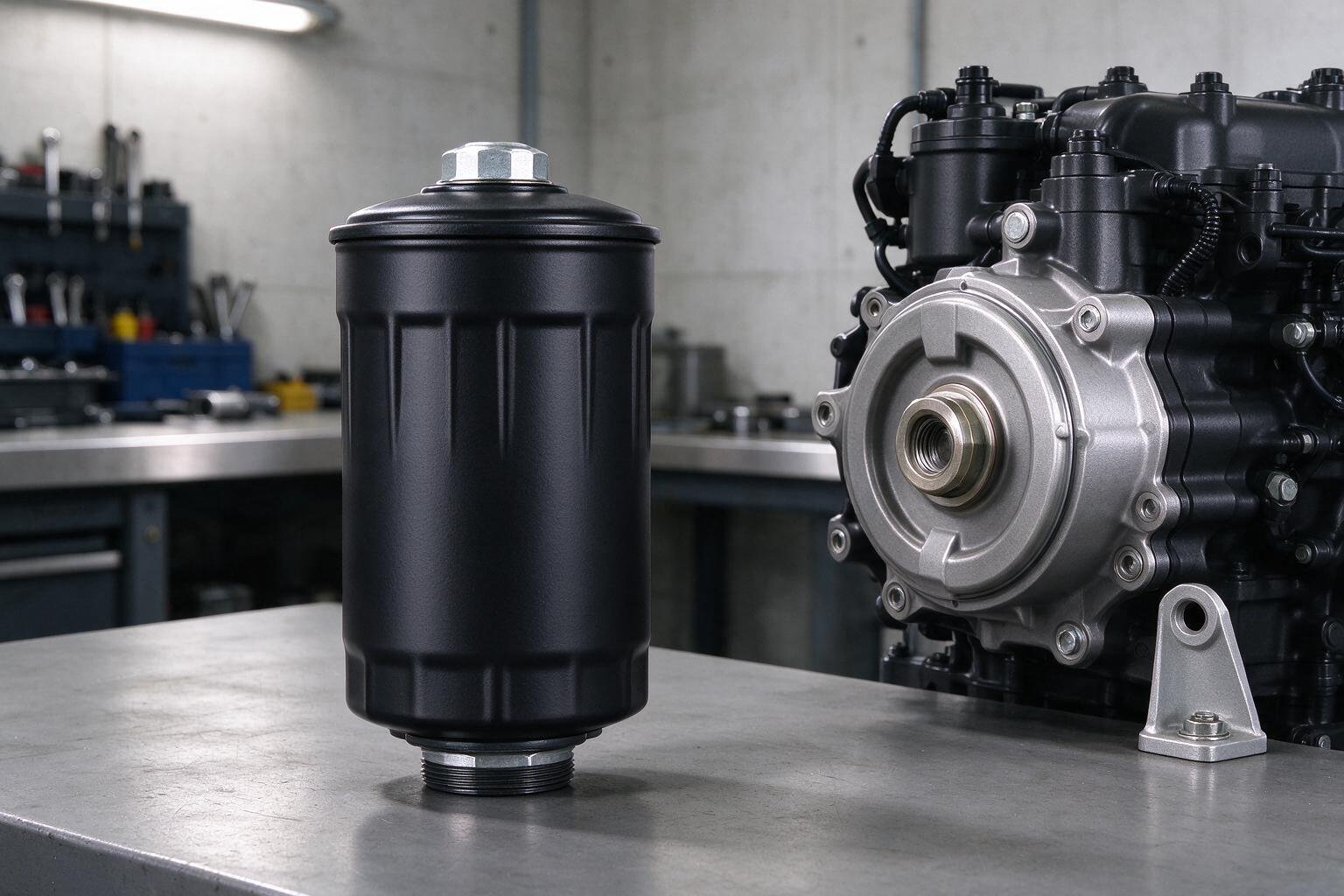
The Cummins 4BT is the 3.9 L four-cylinder member of the B-series family, and this Cummins 4BT oil filter buying guide begins with the fitment details that matter most. Oil filter mounting and thread size are generally consistent across 4BT and 6BT platforms, which allows many filters to interchange between the two. That consistency is a starting point, not a confirmation. Repair shops should verify fitment against the engine serial number and the filter head part number before committing to a stock order.
Full-Flow Spin-On Filters: What the 4BT Uses
The standard 4BT configuration uses a single full-flow spin-on filter that processes all oil on each pass through the lubrication circuit. This differs from bypass filtration systems, where only a fraction of the oil flow is filtered at any given time. On a full-flow setup, the filter must handle the engine’s entire oil pump output, which places importance on correct flow characteristics and pressure ratings.
Thread and Gasket Fitment
The typical thread size on common B-series filter heads is 3/4-16 UNF, though some variants differ. Repair shops should confirm thread size against the actual filter head rather than assuming the common specification applies. Gasket diameter and gasket type—square-cut or O-ring—must match the groove machined into the head. A mismatched gasket can cause external leaks or internal oil pressure loss if the seal does not seat correctly.
Specifications That Distinguish Correct Filters from Lookalikes
Several specifications separate a correct filter from a dimensionally similar substitute:
- Canister burst pressure: the pressure at which the housing fails; must exceed the engine’s maximum oil pressure with margin.
- Anti-drainback valve: prevents oil from draining back to the sump during shutdown, reducing dry-start wear.
- Bypass valve opening pressure: determines when oil routes around the media during cold starts or media loading.
Bypass Valve Configuration
Filters without an internal bypass valve rely on the bypass valve in the filter head. Mixing the two designs—installing an internally bypassed filter on a head with its own bypass, or the reverse—can result in unfiltered oil flow or filter media rupture. Maintenance teams should verify which bypass arrangement the specific engine uses before stocking filters.
Bypass and Combination Filter Options
Bypass (secondary) filters draw a small portion of the oil stream, typically 5 to 10 percent of pump output, and pass it through a finer media than the full-flow element can support. On a Cummins 4BT, the full-flow filter protects the bearings and must remain in place; a bypass unit supplements it by capturing soot and particles in the 2 to 5 micron range that the full-flow element lets through. Bypass filtration never replaces the full-flow filter.
Combination units integrate a full-flow element and a bypass element in a single canister. These save plumbing and space compared with two separate housings, but they require adequate mounting clearance on the 4BT and correct port routing for both circuits. Shops should confirm the canister clears the exhaust manifold and frame rail before ordering, and should verify that the full-flow outlet feeds the main gallery while the bypass outlet returns separately.
Bypass filtration is best suited to high-hour fleet and stationary 4BT engines that run extended oil drain intervals. It does not remove the need for full-flow filtration, and oil analysis should still drive drain decisions. Any added bypass circuit must return oil to a low-pressure point as specified by the filter maker, such as a port on the timing cover or a dedicated return fitting. Routing the return to a pressurized gallery or a restricted location can alter oil pressure readings and cause false diagnostics. Repair teams should document the return point in the service record so later technicians do not mistake a bypass return for a fault.
Micron Ratings, Efficiency, and Beta Ratios
Nominal micron ratings are not standardized across the filter industry. Two filters labeled “10 micron” may remove very different amounts of contaminant at that size. For the Cummins 4BT, buyers should compare filters using beta ratios at a stated micron size. Beta 200 at 10 micron, for example, means 200 particles of 10 micron or larger enter for every one that passes, or 99 percent efficiency at that size. A beta ratio without a stated micron size is not a useful specification.
Typical full-flow diesel filters are rated in the 15–25 micron range at high efficiency. Finer media increases restriction, so the filter must be matched to the oil pump output and the bypass valve setting. A filter that is too restrictive may run in bypass during cold starts or high-load operation, sending unfiltered oil to the bearings.
Absolute and nominal ratings differ significantly. A filter advertised as “10 micron nominal” may capture far less than a Beta-rated equivalent at the same size. Where published data exists, compare beta ratios at 10, 20, and 25 micron rather than relying on a single nominal figure.
Higher-efficiency media can shorten filter life in soot-heavy or sludged engines, because captured contaminant loads the element faster and may trigger the bypass sooner. Fleet buyers should weigh change interval against efficiency and confirm the filter meets the engine’s bypass and restriction requirements.
| Rating type | Meaning | Use in comparison |
|---|---|---|
| Nominal micron | Approximate capture size, not standardized | Marketing reference only |
| Beta 75 | 98.7 percent efficiency at stated size | Common full-flow target |
| Beta 200 | 99 percent efficiency at stated size | High-efficiency reference |
| Absolute | Defined capture at stated size | Most reliable, when published |
Cross-Reference and Counterfeit Risk
Cross-referencing a Cummins 4BT oil filter requires two identifiers: the filter manufacturer’s number and the Cummins part number. A valid cross-reference matches both, then confirms thread size and pitch, gasket dimensions, bypass valve setting, and overall canister dimensions against the original specification. A filter that threads correctly but carries the wrong bypass setting can open early or fail to open at the intended differential pressure, which affects cold-start oil delivery and full-flow filtration.
Counterfeit filters circulate in some supply chains, including online marketplaces and unbranded jobber stock. Authorized distributors remain the most reliable source. On receipt, inspect packaging print quality and label consistency, check for laser-etched or dot-matrix codes that match the manufacturer’s format, and examine the filter media through the inlet holes where visible. Genuine media is uniform and securely bonded; counterfeit media often shows loose pleats, uneven spacing, or adhesive squeeze-out.
Cross-reference charts list “equivalent” filters that may differ in bypass pressure or media area even when thread and gasket dimensions match. Treat any chart as a starting point for identification, not final confirmation. Confirm the candidate filter against the engine’s published specification before installation.
For fleet stock, maintain a documented approved list per engine CPL (Critical Parts List). The CPL identifies the correct filtration configuration for that build, and a written approved list prevents incorrect filters from being fitted during service, particularly when multiple engine variants share a storeroom.
Change Intervals and Oil Analysis
The baseline oil and filter change interval for a Cummins 4BT should come from the engine operator’s manual for the specific rating and build. That figure is a starting point, not a fixed rule. Duty cycle, fuel sulfur content, and soot loading all move the practical interval. Engines run on short trips, frequent cold starts, or extended idling accumulate soot and moisture faster and should be serviced on the shorter side of the manual’s range. High-sulfur fuel and heavy-load, high-soot duty also shorten usable filter life.
For fleet 4BT units, oil analysis is the practical basis for extending drains. A routine sample covering soot, viscosity, wear metals, and total base number (TBN) shows whether the oil is still within limits at the planned interval. Shops that trend these results over several services can justify longer drains with evidence rather than assumption. A single sample is less useful than a consistent history.
The filter should be changed whenever the oil is changed. Mixing a fresh filter with oil that has already loaded it defeats the purpose of the service. Where the mounting orientation allows, pre-fill the new filter with clean oil to reduce dry-start time and the brief period of low oil pressure at startup. Filters mounted upside down or at an angle cannot be pre-filled safely.
Record the filter part number, service date, and engine hours at every change. This log catches repeat fitment errors across a fleet, such as a wrong-thread or wrong-bypass filter being substituted, before they cause damage.
Installation and Inspection Checks
Correct installation of the oil filter on a Cummins 4BT protects both the filter and the engine. Before threading the new filter, the installer should coat the gasket with clean engine oil. This lubricates the seal and allows the filter to seat without binding or tearing the gasket. The filter should then be threaded on by hand until the gasket contacts the filter head, followed by tightening per the filter maker’s instruction, typically three-quarters to one full turn after contact. A wrench should not be used unless the filter maker specifically calls for one, since over-tightening distorts the gasket and complicates later removal.
Before mounting the new filter, the installer must confirm that the old gasket came off with the removed filter and is not stuck to the filter head. A doubled gasket is a common cause of leaks and low oil pressure on the 4BT, and the fault is easy to overlook during a routine service.
After start-up, the engine should be checked for leaks at the filter seam and mounting face. Oil pressure should reach normal within the expected time for the engine; slow pressure build-up warrants investigation before the unit returns to service. During routine oil sampling, removed filters can be cut open and the media inspected for metal particles, sludge, or collapsed pleats. These findings point to engine wear or a filter problem and should be recorded and acted on.
Sourcing Checklist for Shops and Fleets
A consistent oil filter procurement process reduces the risk of mismatched parts on Cummins 4BT engines, where filter mounting and bypass characteristics vary by application and CPL.
Specify by multiple identifiers. Purchase orders should list the Cummins part number, the engine CPL, and the filter maker’s own catalog number. The CPL narrows the build configuration, since 4BT variants used in industrial, marine, and automotive chassis applications can carry different filter heads and remote-mount arrangements. Cross-referencing the maker’s number confirms the supplier is shipping the intended product rather than a look-alike.
Require written specifications. The supplier should state, in writing on the quote or order acknowledgment, the thread size, gasket inside and outside dimensions, bypass valve opening pressure, and filtration efficiency rating. These figures allow the shop to verify the filter against the engine’s lubrication circuit requirements before installation. A supplier unwilling to document them is a supply risk.
Audit incoming stock. Periodic checks should cover packaging integrity, label accuracy against the part number ordered, and dimensional match against a known-good sample kept on the shelf. Measure thread pitch and gasket dimensions with calipers; do not rely on visual comparison alone. Record the audit date and findings.
Hold buffer stock. A small reserve of the confirmed filter for each engine variant in the fleet prevents substitutions made under time pressure. Size the buffer to cover the interval between orders plus one service cycle, and rotate stock so older units are used first.
| Check | Method | Frequency |
|---|---|---|
| Part number and CPL match | Compare PO to label | Every receipt |
| Thread and gasket dimensions | Caliper against sample | Each new lot |
| Bypass valve pressure | Supplier documentation | At supplier qualification |
| Packaging and labeling | Visual inspection | Every receipt |