
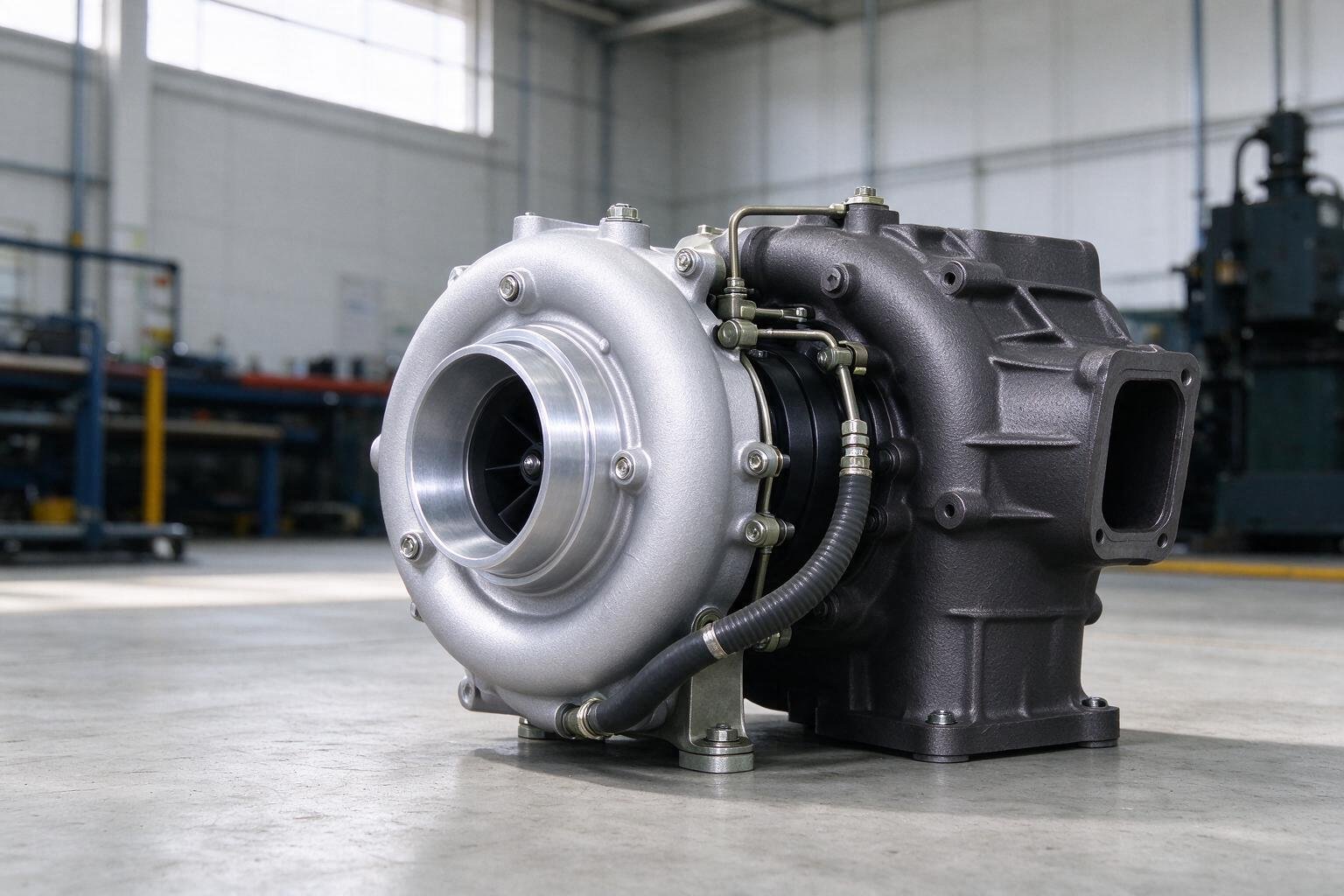
This Cummins 4BT turbocharger buying guide starts with the fact that the 4BT is a 3.9-liter four-cylinder diesel used across step vans, box trucks, generators, and industrial equipment. Turbocharger configuration varies widely by application and rating year, which is why any Cummins 4BT turbocharger buying guide has to begin with part identification rather than price. A unit specified for a generator set may carry a different compressor housing, turbine housing, or wastegate setting than one built for a road-going step van, even when both engines share the same displacement. Treating the 4BT as a single turbo application is the first error in the buying process.
Identify the Engine and Turbocharger Variant Before Ordering
Correct turbocharger selection for a Cummins 4BT begins with engine identification, not vehicle application. The engine serial number (ESN) is stamped on the data plate on the block and is the primary key for any Cummins parts lookup. Vehicle model year is unreliable for this purpose, because 4BT engines were installed across many chassis and repower applications, and the same model year can carry different calibrations.
The CPL (Control Parts List) number defines the specific build configuration, including the turbocharger and fuel settings. Two engines sharing an ESN prefix may carry different CPLs and therefore different turbochargers. The 4BT commonly used Holset H1C and WH1C units, with variation in compressor housing, turbine housing A/R, and wastegate versus non-wastegate configuration. Confirm whether the unit is wastegate-controlled and, if so, whether the actuator is referenced to boost pressure only or to a charge-air cooler signal.
Before removal, photograph the original unit’s data tag, housing castings, and actuator bracket. Tag data often outlasts the tag itself, and casting numbers can resolve a mismatch when the tag is missing or illegible.
| Item to record | Source |
|---|---|
| Engine serial number (ESN) | Data plate on block |
| CPL number | Data plate or Cummins lookup by ESN |
| Turbo model and tag data | Compressor housing tag |
| Housing casting numbers | Compressor and turbine housings |
| Actuator reference type | Actuator bracket and plumbing |
Do not substitute a turbocharger from a higher-rated 4BT or a 6BT variant without verifying that fuel delivery and governor settings match the donor calibration.
Reading the Turbocharger Data Tag and Casting Numbers
Holset turbocharger data tags typically list three items: the assembly part number, a serial number, and the model designation, such as H1C or WH1C. The assembly number is the primary identifier for ordering and cross-referencing. The serial number supports build-date and warranty tracing. The model designation confirms the frame family and narrows the range of compatible components.
Compressor and turbine housing castings carry their own numbers, separate from the data tag. These casting numbers help confirm the A/R ratio and trim when the tag is missing or unreadable. Because housings can be swapped between units over a service life, casting numbers should be read as evidence of what is currently fitted, not proof of the original build.
A missing or illegible tag is a red flag on core returns. Shops should document the condition at receipt, photograph the housings, and identify the unit by casting numbers and measured dimensions (compressor inducer and exducer, turbine wheel dimensions, and housing A/R) rather than by tag alone.
Cross-reference the assembly number against the engine CPL to confirm the unit matches the original calibration. A supersession may fit the engine but require other changes, such as different plumbing, a revised wastegate setting, or an updated fuel setting. Aftermarket “equivalent” numbers may map to several OEM assemblies, so confirm the mapping covers the exact CPL in question before installation.
| Identifier | Location | Use |
|---|---|---|
| Assembly part number | Data tag | Primary ordering and cross-reference |
| Serial number | Data tag | Build date and warranty tracing |
| Model designation (H1C, WH1C) | Data tag | Frame family identification |
| Housing casting numbers | Compressor and turbine housings | A/R and trim confirmation |
| CPL | Engine data plate | Calibration match |
Inspecting a Core or Replacement Unit
A systematic inspection separates a serviceable core from scrap and prevents repeat failures after installation.
Shaft Play
Measure axial and radial shaft play with a dial indicator. Radial play above roughly 0.003 to 0.005 inch at the compressor nut indicates bearing wear. Axial play beyond the published specification points to thrust bearing distress. Record both readings before purchase.
Wheel and Housing Contact
Inspect the compressor and turbine wheels for blade tip contact with the housing. Any rubbing marks indicate the unit is not rebuildable as a simple bearing job; the housing or rotating assembly is compromised.
Oil Path
Look for oil coking in the bearing housing and center housing drain. A restricted drain path is a common cause of repeat turbo failure, so a coked core often signals an engine-side problem that will destroy the replacement.
Wastegate
Verify the wastegate flapper seats fully and the actuator moves freely through its full stroke without binding. A sticking actuator causes boost control faults that mimic turbo failure.
Corrosion and Cracks
Check the compressor housing inlet and outlet for corrosion pitting, and the turbine housing for cracks at the wastegate port and inlet flange. Cracks at these locations typically condemn the housing.
Oil Feed Fitting
Confirm the oil feed fitting thread and restrictor size match the engine. Incorrect restrictors cause either oil starvation or seal leakage.
| Check | Acceptable | Reject |
|---|---|---|
| Radial play at compressor nut | Below 0.003 inch | Above 0.005 inch |
| Blade tip contact | None | Any rubbing marks |
| Bearing housing and drain | Clean, unrestricted | Coking present |
| Wastegate flapper and actuator | Full free stroke | Binding or poor seat |
| Housings | No pitting or cracks | Cracks at port or flange |
| Oil feed restrictor | Matches engine spec | Mismatched size |
New, Remanufactured, or Rebuilt: What the Options Actually Mean
New OEM-assembly turbochargers offer full traceability from the manufacturer and consistent build quality, but they carry the highest cost. For older 4BT ratings, lead times can also run long, since low-volume part numbers may be scheduled around current production demand.
Factory remanufactured units are built to a defined specification: wear components are replaced, the assembly is tested, and a warranty applies. Documentation should state that specification explicitly, including which components are new, which are reused after inspection, and what tolerances apply. A reman unit without a stated build specification is difficult to evaluate.
Shop-rebuilt units vary enormously in quality. Buyers should ask three questions: which components were replaced, whether the center housing was machined or simply cleaned, and whether the assembled unit was VSR balanced. Reusing the original compressor and turbine wheels is acceptable only if both pass dimensional checks and crack inspection, such as dye penetrant or magnetic particle testing.
Balance quality is the single largest predictor of rebuild life. High-speed VSR (vibration sorting rig) balancing after assembly is the benchmark to request; a rebuild balanced only as individual components does not account for stack-up error.
Warranty terms matter more than warranty length. Confirm in writing whether labor and consequential damage are covered or excluded, and what documentation is required for a claim.
| Option | Traceability | Cost | Typical warranty basis |
|---|---|---|---|
| New OEM-assembly | Full | Highest | Manufacturer terms |
| Factory remanufactured | Build specification on file | Mid to high | Rebuild-specific terms |
| Shop-rebuilt | Varies by shop | Lowest to mid | Shop-defined; verify coverage |
Fitment Checks That Prevent Comebacks
Most premature 4BT turbocharger failures trace back to installation conditions rather than the unit itself. A short pre-installation inspection sequence catches the common causes before the engine is started.
Oil System Checks
Confirm the oil feed line condition and internal cleanliness. A partially blocked feed line will destroy a new unit within minutes of startup, and the damage is not covered under any reasonable warranty position. Replace lines of unknown age or flush them and verify flow.
Replace or thoroughly clean the oil drain line, then verify it has continuous downward slope to the block with no low spots. A sagging drain section traps oil, raises crankcase pressure at the seal, and produces leaks that mimic a failed turbo.
Air and Exhaust Path
Check the air filter and intake piping for restriction and for debris that can be drawn into the compressor. Loose fasteners, gasket fragments, and dust from a collapsed filter element all cause wheel damage quickly.
Inspect the exhaust manifold and downpipe flanges for flatness. Warped flanges cause gasket leaks and false boost complaints, often leading to a second turbo replacement that solves nothing. Resurface or replace as needed.
Charge-Air and Startup
Verify charge-air cooler and piping integrity if fitted. A boost leak mimics turbo failure and leads to unnecessary replacement; pressure-test the system before condemning the unit.
Prime the turbocharger oil feed before first start, and instruct the operator to idle the engine for a short period before load application. This step takes minutes and protects the bearing assembly during the first critical heat cycle.
Matching the Turbocharger to Fuel and Boost Settings
On the Cummins 4BT, boost pressure is a product of fuel delivery and the wastegate setting, not of the turbocharger alone. A larger turbocharger fitted without a corresponding fuel adjustment changes both driveability and emissions behavior: the engine may run leaner under load, spool more slowly, and no longer match the calibration the application was certified against. Repair shops should treat turbo replacement and fuel setting review as a paired decision.
A higher-flow compressor can reduce exhaust gas temperature at a given fuel rate, which matters in continuous-duty applications. The trade-off is turbo lag, particularly in stop-and-go delivery duty where the engine cycles through low-load operation repeatedly. The operating point that suits a line-haul route rarely suits a multi-drop route.
Wastegate actuator settings should be verified against the engine specification rather than adjusted by trial. Trial adjustment obscures the baseline and makes later diagnosis difficult. On non-wastegate units, the turbine housing A/R is the primary boost control variable; substituting housings moves the operating point and should be treated as a calibration change.
| Change | Primary effect | Record to update |
|---|---|---|
| Higher-flow compressor | Lower EGT at given fuel rate; more lag | Turbo part number, EGT baseline |
| Wastegate actuator reset | Altered peak boost | Actuator setting vs. spec |
| Turbine housing A/R swap | Shifted operating point | Housing A/R, boost log |
| Fuel delivery adjustment | Changed boost and smoke | Fuel setting, test results |
Any departure from the original calibration should be documented in the fleet maintenance record so future diagnosis starts from a known state.
Supplier Evaluation and Documentation for Fleet Buyers
Fleet buyers should treat the turbocharger purchase as a documentation exercise as much as a sourcing decision. Before placing an order, request the assembly part number, unit serial number, and rebuild specification in writing. These identifiers allow the shop to verify that the supplied unit matches the engine’s CPL configuration and to trace the unit through its service life.
Ask the supplier to state the balancing method used and to provide the test record for the specific unit being shipped, not a generic description of the shop’s process. A test record tied to the serial number confirms that the individual assembly was verified rather than sampled from a batch.
Core terms deserve equal scrutiny. Confirm the core charge, the acceptance criteria (cracked housings, seized shafts, missing components, and similar conditions), and who pays return freight. Core disputes are a common hidden cost in turbocharger programs and are best resolved before the first shipment.
For fleet stocking, standardize on the CPL-specific assembly numbers in use across the fleet rather than a single “universal” 4BT unit. Mixed applications with different ratings and fueling will not perform correctly with one assembly number.
Track failure modes by unit serial number. Repeat failures on the same application typically indicate an installation or duty-cycle issue rather than a parts defect, and the pattern should be investigated before another unit is installed.
Retain the removed unit’s tag data and inspection findings with the repair order. This record supports warranty claims and provides the evidence trail a supplier will request when a claim is filed.